There are soups that warm you up. There are soups that are genuinely good for you. And then in that increasingly rare and wonderful overlap there are soups that do both things simultaneously while also being beautiful to look at, quick enough for a weeknight, and so full of fresh, vibrant flavor that you find yourself making them again the following week without even consciously deciding to.
This Pea, Leek, and Zucchini Soup is exactly that soup and the cottage cheese trick at the heart of it is the detail that makes it genuinely different from every other green vegetable soup you have ever made.
This is a completely blended soup with a texture that is thick, silky, and almost creamy without a single drop of actual cream in it.
The creaminess comes from cottage cheese blended directly into the soup along with the softened leek, zucchini, frozen peas, and baby spinach producing a silky smooth base with a protein content that turns what might otherwise be a light vegetable starter into a genuinely satisfying meal.
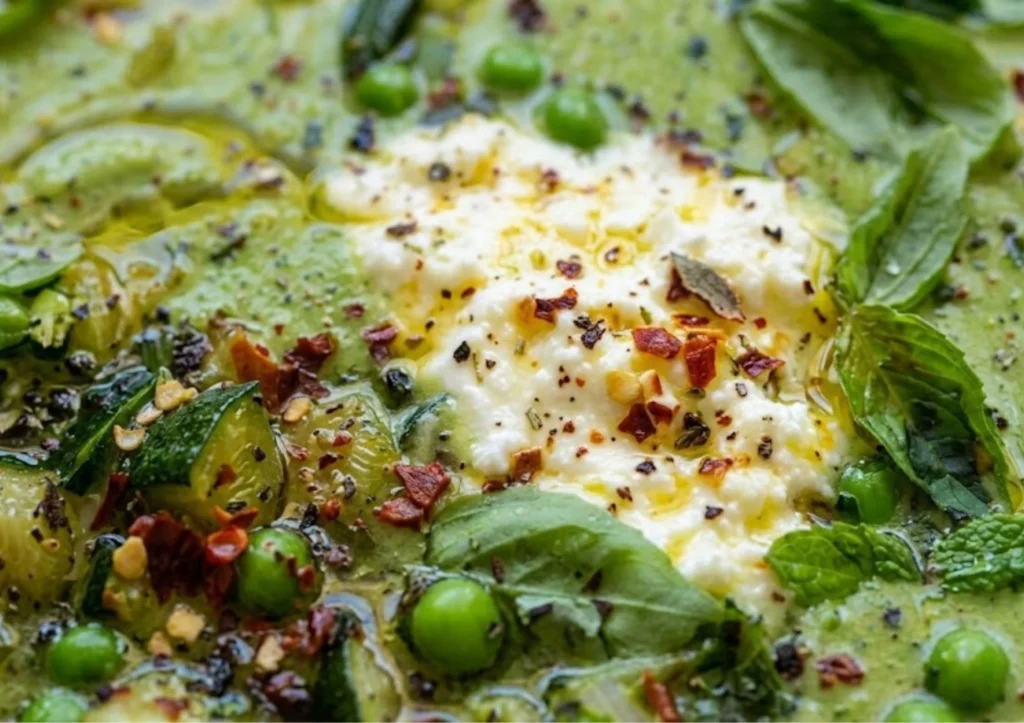
Finished with reserved whole vegetables on top, a drizzle of good olive oil, fresh lemon zest, and scattered fresh mint and basil leaves this is a soup that looks as considered and as carefully put together as something you would order at a farm to table restaurant, and it takes less than 30 minutes from the time you put the pan on the stove.
Why Cottage Cheese Is the Smartest Thing You Can Add to a Vegetable Soup
Most creamy vegetable soups achieve their texture with heavy cream, butter, or a flour based roux. These additions work they produce a rich, smooth, satisfying soup but they add significant calories and fat without adding meaningful protein or nutrition.
Cottage cheese takes a completely different approach and achieves the same silky, creamy result while actually improving the nutritional profile of the soup significantly.
When you blend cottage cheese into a hot soup, it emulsifies into the liquid the curds break down completely and the proteins and milkfat distribute evenly through the soup, creating a smooth, thick, slightly tangy base that behaves exactly like cream in terms of texture but delivers a fundamentally different nutritional outcome.
A 9 ounce container of full fat cottage cheese adds approximately 28 grams of protein to the full batch which across four servings means approximately 7 additional grams of protein per bowl from the cottage cheese alone, plus whatever protein the peas and spinach contribute.
The mild tanginess of cottage cheese also adds a subtle depth to the soup that plain cream does not a slight brightness that plays well against the sweetness of the peas and the gentle onion flavor of the leek.
Ingredients
For the Soup:
- 3 tablespoons olive oil
- 1 large leek, halved lengthways and finely sliced — white and pale green parts only (available in the produce section of most major supermarkets — look for firm, tightly wrapped leeks without yellowing)
- 3 medium zucchini, diced into roughly half-inch pieces
- 3 to 4 garlic cloves, roughly chopped
- 4 cups vegetable broth (approximately 1 liter — low-sodium preferred for better seasoning control)
- 1 cup water
- 2 cups frozen peas (no need to thaw before adding)
- 2 large handfuls fresh baby spinach
- Salt and black pepper to taste
- One 9 oz container full-fat cottage cheese (approximately 250 grams — Good Culture, Daisy, or Breakstone’s full-fat cottage cheese — full-fat blends more smoothly than low-fat)
- Extra virgin olive oil for drizzling
- 1 fresh lemon for zesting
- A handful each of fresh small mint leaves and fresh basil leaves for scattering
Why These Specific Vegetables Work Together
The three main vegetables in this soup leek, zucchini, and peas are chosen for their complementary flavor profiles as much as their nutritional qualities.
Leek is a member of the allium family along with onion and garlic, but it has a significantly milder, sweeter, more delicate flavor than either. When softened in olive oil, it provides a gentle, sweet, slightly savory base that is more nuanced than a standard onion would produce.
It essentially disappears into the background of the finished soup while providing an important flavor foundation.
Zucchini is mild, slightly sweet, and has a very high water content which means it contributes to the soup’s body and volume without adding a strong flavor that might compete with the peas or the herbs.
It blends into a completely smooth consistency and essentially becomes part of the creamy texture of the finished soup.
Frozen peas are the flavor star of this soup their natural sweetness, bright green color, and slightly earthy fresh flavor are what give the soup its characteristic taste and vivid color.
Using frozen peas rather than fresh is actually preferred in this recipe frozen peas are picked and frozen at peak ripeness and sweetness, while fresh peas available year-round at supermarkets are often past their peak and starchier.
The baby spinach adds color depth, additional iron and nutrients, and a very mild earthiness that rounds out the brightness of the peas without competing with them.
Step by Step Instructions
Step 1 Soften the leek and zucchini
Place a large soup pot or Dutch oven over medium high heat. Add the olive oil and allow it to heat until shimmering.
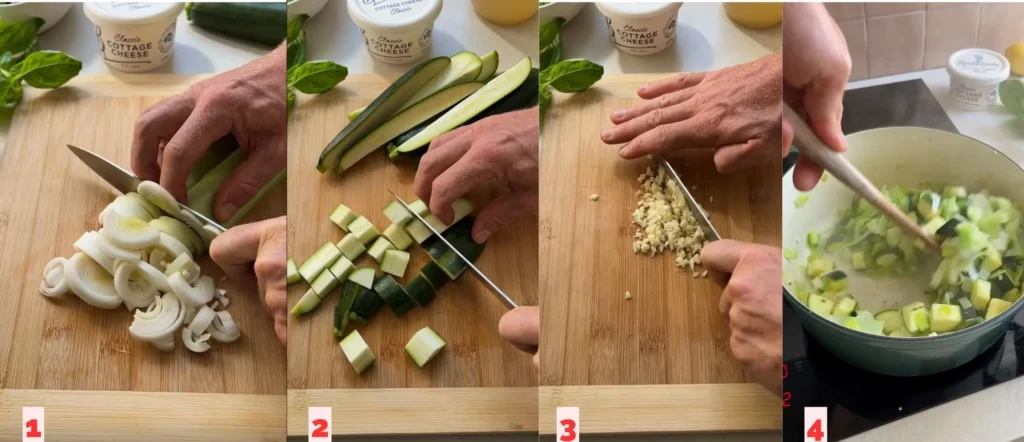
Add the finely sliced leek and diced zucchini along with a generous pinch of salt and black pepper. Cook for 3 to 4 minutes, stirring frequently, until the vegetables begin to soften and wilt the leek should become translucent and the zucchini should start to lose its raw firmness.
Step 2 Add garlic and cook briefly
Add the roughly chopped garlic to the softened vegetables. Stir and cook for exactly 1 minute just long enough to soften the garlic and take the raw edge off its flavor without allowing it to brown or become bitter.
Step 3 Add broth and water and simmer
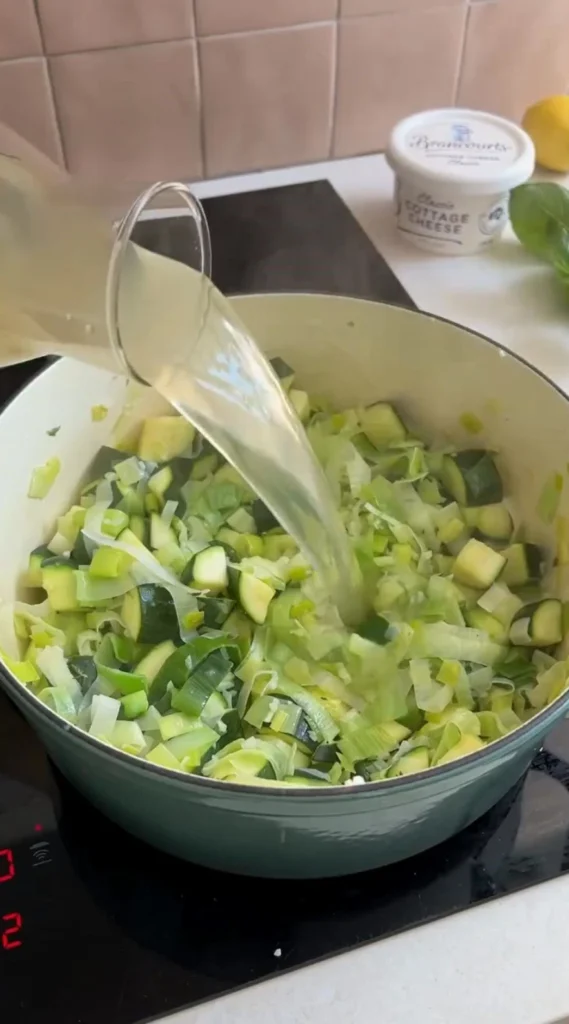
Pour the 4 cups of vegetable broth and 1 cup of water into the pot. Bring to a boil, then reduce to a steady simmer. Cook for 6 to 8 minutes until the zucchini is completely tender and cooked through it should be easily pierced with a fork with no resistance.
Step 4 Add peas and spinach
Add the frozen peas directly to the simmering pot no need to thaw. Add both large handfuls of baby spinach.
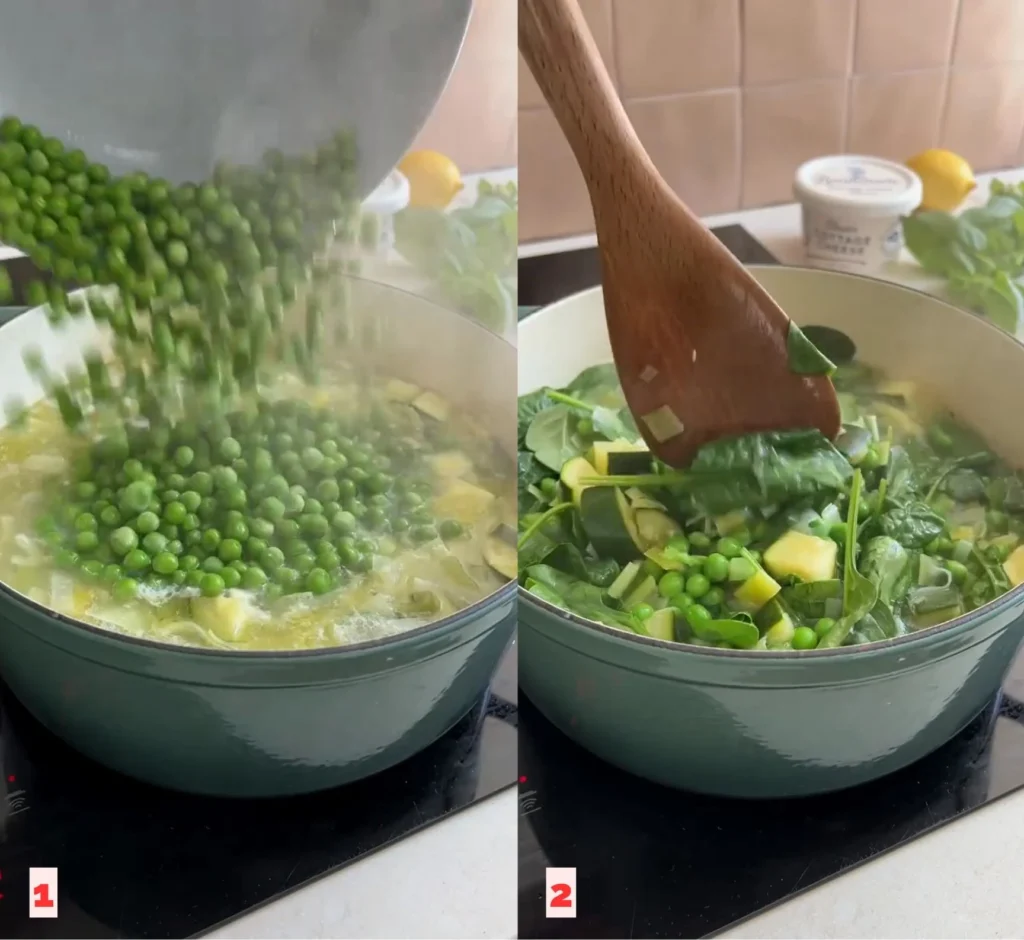
Stir through to wilt the spinach and heat the peas this takes approximately 1 to 2 minutes. The pot will be brightly colored and fragrant at this point.
Step 5 Reserve whole vegetables for topping
Before blending, use a slotted spoon to remove approximately 1 cup of the whole cooked vegetables from the soup and transfer to a small bowl.
These reserved vegetables will be used as a topping for serving keeping some pieces whole creates a beautiful textural contrast in the finished bowl against the smooth blended base.
Step 6 Blend with cottage cheese
Add half of the cottage cheese to the soup in the pot. Using an immersion blender, blend directly in the pot until completely smooth or transfer in batches to a countertop blender, blending each batch with some of the cottage cheese until thick and silky.
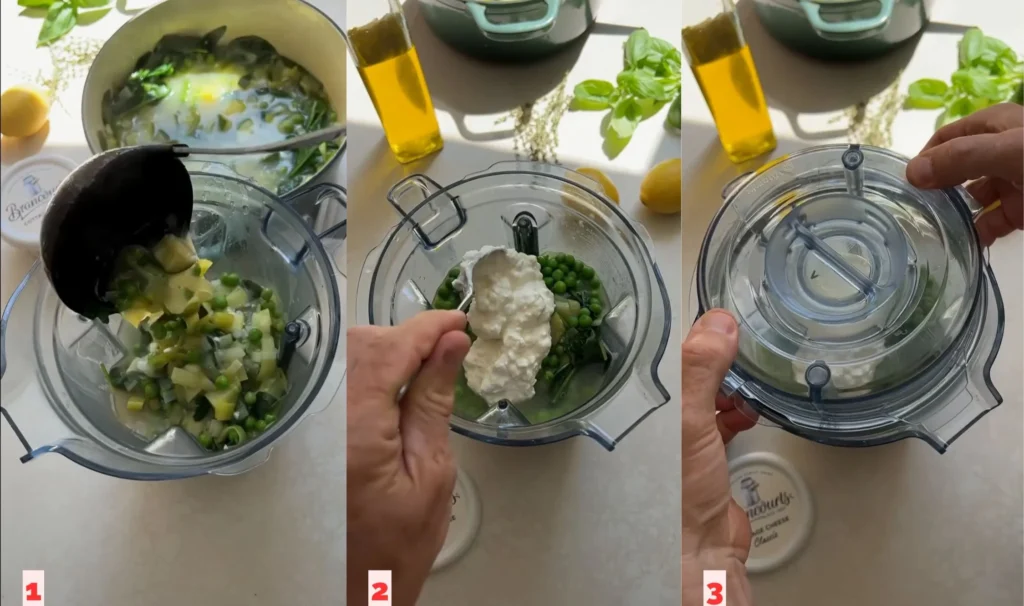
Blend thoroughly the cottage cheese should be completely incorporated with no visible curds remaining. The finished soup should be smooth, thick, vibrantly green, and slightly creamy in appearance.
Step 7 Season and serve
Taste the blended soup and adjust seasoning with additional salt, pepper, and a small squeeze of fresh lemon juice if desired.
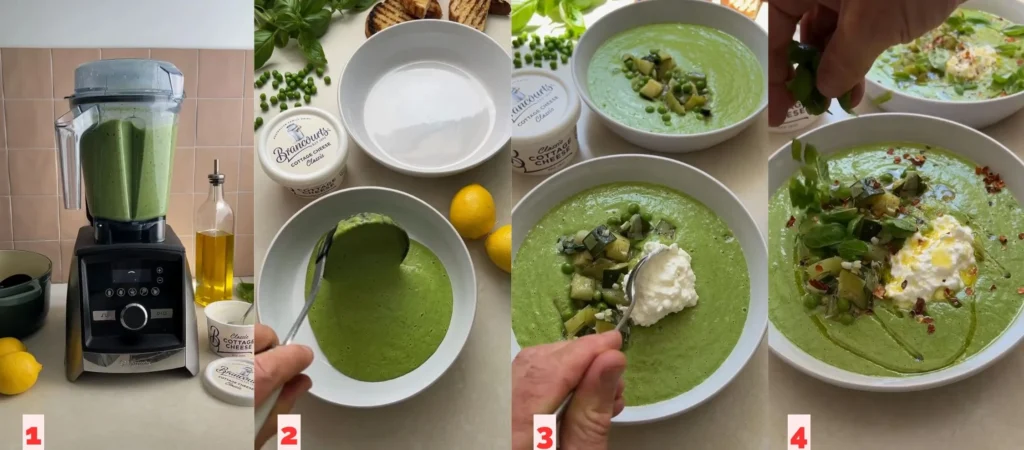
Ladle hot soup into serving bowls. Spoon the reserved whole vegetables into the center of each bowl. Add a few spoonfuls of the remaining cottage cheese dotted around the top.
Drizzle extra virgin olive oil generously over each bowl. Zest the fresh lemon directly over each serving. Scatter fresh small mint leaves and basil leaves over the top. Serve immediately while hot.
Tips for Perfect Pea, Leek, and Zucchini Soup Every Time
Cook the leek and zucchini until genuinely wilted and softened before adding the liquid — vegetables that are not properly softened before blending can produce a slightly grainy rather than silky smooth finished texture.
Use full-fat cottage cheese for blending — it emulsifies more smoothly and completely than low-fat or non-fat varieties and produces a creamier, richer base.
Reserve the whole vegetables before blending — this simple step creates a textural contrast in the finished bowl that makes the soup look and eat much more interestingly than a fully smooth bowl of soup would.
Blend very thoroughly — any remaining cottage cheese curds in the finished soup produce an uneven, slightly lumpy texture. Blend until completely uniform and smooth.
Add the lemon zest just before serving rather than during cooking — heat destroys the fresh, aromatic quality of lemon zest and reduces it to a flat citrus note. Zesting directly over the finished bowl gives the most vibrant lemon fragrance.
Scatter the mint and basil immediately before serving — fresh herbs wilt quickly in hot soup and lose both their appearance and their flavor within minutes of contact with the heat.
Serving Ideas
Serve in wide, shallow bowls for the most elegant presentation the reserved vegetables, cottage cheese dollops, olive oil drizzle, lemon zest, and herbs are all visible components that deserve a wide surface to display on.
Pair with thick slices of toasted sourdough or crusty bread for a complete, satisfying lunch or light dinner. For a more substantial meal, serve alongside a simple grain salad or a protein of your choice.
This soup also works beautifully chilled on warm days allow to cool, refrigerate for at least two hours, and serve cold with the same toppings for a refreshing summer soup variation.
Yes the blended soup base keeps beautifully in an airtight container in the refrigerator for up to 3 days. Store the reserved whole vegetables and the remaining cottage cheese separately and add them fresh when serving. Reheat the soup base gently over medium-low heat, stirring frequently, and add a small splash of water or vegetable broth if it has thickened during storage. Add the toppings fresh when serving for the best presentation.
Yes with one caveat dairy based soups can sometimes separate slightly after freezing and thawing. Freeze the blended soup base without the cottage cheese topping in freezer-safe containers for up to 2 months. Thaw overnight in the refrigerator and reheat gently, using an immersion blender or vigorous stirring to restore the smooth consistency if any separation has occurred. Add fresh cottage cheese and toppings when serving.
Full-fat Greek yogurt can substitute in equal quantities it produces a similar creamy texture with a slightly tangier flavor. Plain cream cheese blended in smaller quantities (approximately half the amount) produces a richer, denser result. For a dairy-free version, silken tofu blended until smooth is the closest texture substitute and adds comparable protein. Plain cashew cream also works well and produces a beautifully smooth, neutral base.
One medium yellow onion makes the most straightforward substitute it produces a slightly stronger, less delicate flavor but works well in this soup. Two to three shallots produce a closer result to leek with a sweeter, more nuanced flavor. Green onions (scallions) can substitute in a pinch use the white and pale green parts and add them at the same stage as the leek.
Yes this is one of the best soups for meal prep. Make a full batch, allow to cool completely, and divide into individual airtight containers. Store in the refrigerator for up to 3 days. Keep the fresh herb, lemon zest, and cottage cheese toppings separate and add them fresh each day when reheating. The soup base reheats quickly in a microwave or on the stovetop and tastes excellent for up to 3 days after making.
The cottage cheese is the only non vegan ingredient. Substitute with an equal amount of silken tofu blended until smooth, or with plain cashew cream made by blending soaked raw cashews with water until smooth. Both substitutes produce a similar thick, creamy texture without any dairy. All other ingredients in this recipe are naturally vegan.

Pea, Leek, and Zucchini Soup The Silky, Protein Packed Green Soup
Ingredients
- For the Soup:
- 3 tablespoons olive oil
- 1 large leek halved lengthways and finely sliced — white and pale green parts only available in produce section of most major supermarkets — look for firm tightly wrapped leeks without yellowing
- 3 medium zucchini diced into approximately half-inch pieces
- 3 –4 garlic cloves roughly chopped
- 4 cups low-sodium vegetable broth approximately 1 liter
- 1 cup water
- 2 cups frozen peas no need to thaw before adding
- 2 large handfuls fresh baby spinach
- Salt and black pepper to taste
- One 9 oz container full-fat cottage cheese approximately 250 grams — Good Culture, Daisy, or Breakstone’s full-fat recommended — full-fat blends more smoothly than low-fat
- For Serving and Topping:
- Extra virgin olive oil for drizzling
- 1 fresh lemon for zesting directly over finished bowls
- A handful each of fresh small mint leaves and fresh basil leaves
Instructions
- Place a large soup pot or Dutch oven over medium-high heat and add 3 tablespoons olive oil — allow to heat until shimmering.
- Add finely sliced leek and diced zucchini along with a generous pinch of salt and black pepper.
- Cook for 3–4 minutes stirring frequently until vegetables begin to soften and wilt — leek should become translucent and zucchini should start to lose its raw firmness — do not rush this step as properly softened vegetables produce a silkier blended texture.
- Add roughly chopped garlic to the softened vegetables and cook for exactly 1 minute stirring constantly — just long enough to soften garlic without browning or turning bitter.
- Pour 4 cups vegetable broth and 1 cup water into the pot and bring to a boil.
- Reduce to a steady simmer and cook for 6–8 minutes until zucchini is completely tender and easily pierced with a fork with no resistance.
- Add frozen peas directly to the simmering pot — no thawing needed.
- Add both large handfuls of baby spinach and stir through to wilt — approximately 1–2 minutes until spinach is fully wilted and peas are heated through.
- Before blending use a slotted spoon to remove approximately 1 cup of the whole cooked vegetables from the soup and transfer to a small bowl — these are reserved for topping the finished bowls.
- Add half of the cottage cheese to the soup remaining in the pot.
- Using an immersion blender blend directly in the pot until completely smooth and thick — OR transfer in batches to a countertop blender blending each batch with some of the cottage cheese.
- Blend very thoroughly until completely uniform and smooth with no visible cottage cheese curds remaining — the finished soup should be silky thick and vibrantly green.
- Taste blended soup and adjust seasoning with additional salt and pepper as needed.
- Ladle hot soup into serving bowls.
- Spoon reserved whole vegetables into the center of each bowl.
- Add a few spoonfuls of remaining cottage cheese dotted around the top of each bowl.
- Drizzle extra virgin olive oil generously over each serving.
- Zest the fresh lemon directly over each bowl immediately before serving — do not add zest during cooking as heat destroys the fresh aromatic quality.
- Scatter fresh small mint leaves and basil leaves over the top immediately before serving — add at the very last moment as fresh herbs wilt quickly in hot soup.
- Serve immediately while hot.
Notes
Cook leek and zucchini until genuinely wilted and softened before adding liquid — vegetables not properly softened before blending can produce a slightly grainy rather than silky smooth finished texture.
Always use full-fat cottage cheese — it emulsifies more smoothly and completely than low-fat or non-fat varieties and produces a creamier richer base.
Always reserve 1 cup of whole vegetables before blending — this creates a textural contrast in the finished bowl that makes the soup look and eat more interestingly than a fully smooth bowl.
Blend very thoroughly until completely uniform — any remaining cottage cheese curds in finished soup produce uneven slightly lumpy texture.
Add lemon zest just before serving directly over the bowl — never during cooking — heat destroys the fresh aromatic quality of lemon zest.
Scatter mint and basil immediately before serving — fresh herbs wilt within minutes of contact with hot soup losing both appearance and flavor.
Soup base keeps in airtight container in refrigerator for up to 3 days — store reserved vegetables and remaining cottage cheese separately and add fresh when serving.
Reheat soup base gently over medium-low heat stirring frequently — add a small splash of water or vegetable broth if thickened during storage.
Freeze blended soup base without cottage cheese topping in freezer-safe containers for up to 2 months — thaw overnight in refrigerator and reheat gently using immersion blender or vigorous stirring to restore smooth consistency if separation occurs.
Leek substitute: 1 medium yellow onion (stronger less delicate flavor), 2–3 shallots (closer result with sweeter more nuanced flavor), or white and pale green parts of green onions in a pinch.
Cottage cheese substitute: full-fat Greek yogurt in equal quantity (slightly tangier), plain cream cheese in half quantity (richer denser), silken tofu blended smooth (dairy-free closest texture substitute), or plain cashew cream (dairy-free beautifully smooth neutral base).
For vegan version substitute cottage cheese with silken tofu blended smooth or plain cashew cream — all other ingredients naturally vegan.
Soup can be served chilled on warm days — cool completely refrigerate at least 2 hours and serve cold with same toppings for refreshing summer soup variation.
For meal prep divide into individual airtight containers after cooling — keeps up to 3 days — keep fresh herb lemon zest and cottage cheese toppings separate and add fresh each day when reheating.